Hyvä vs. PWA: What’s the Right Choice for Your Magento Store?
 14 mins read

 14 mins read
When a Magento store becomes slow and difficult to maintain, performance optimization is usually the first step. However, if you’re planning a strategic upgrade, a complete front end replacement may be a better solution, often coming down to a choice between Hyvä vs. PWA.
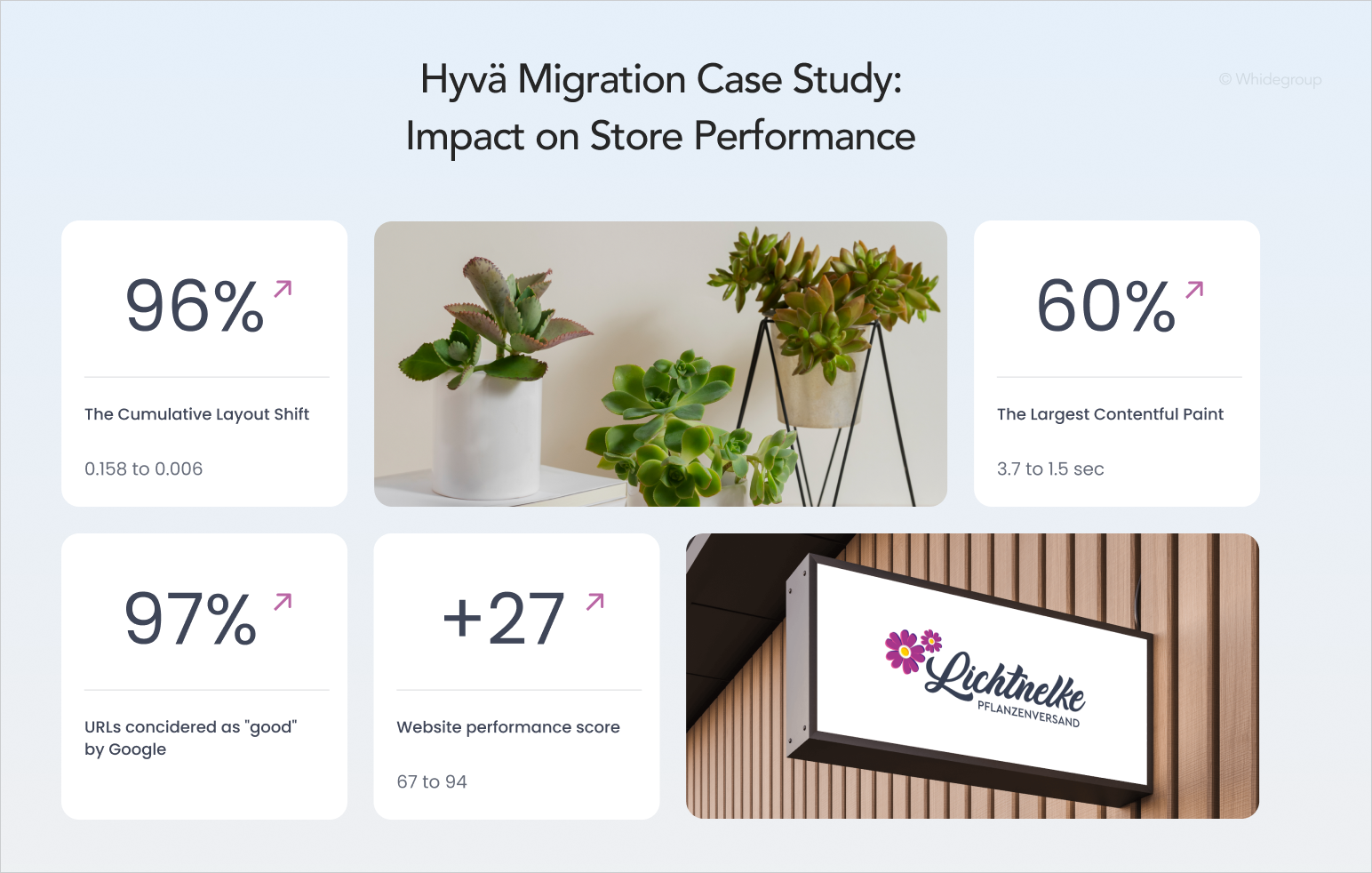
Both Hyvä and Magento 2 PWA solutions speed up your site when implemented correctly. For example, our client got a 27-point jump in performance score after Porto to Hyvä migration.
In this article, we compare both approaches and explain when each one is the right choice for your Magento store.
We help you choose the right solution, not the loudest trend.
The Hyvä theme is a modern front end for Magento 2 designed to solve limitations of traditional Magento storefronts and focused on speed and user experience. After Hyvä implementation, store owners can quickly see improvements in page load times, search visibility, and conversion rates.
While some sources call Hyvä a “headless” solution, it is actually a monolith. Unlike headless architectures, Hyvä does not decouple the front end from the Magento back end via APIs. As a result, Hyvä works only with Magento and cannot be reused with other CMS platforms.
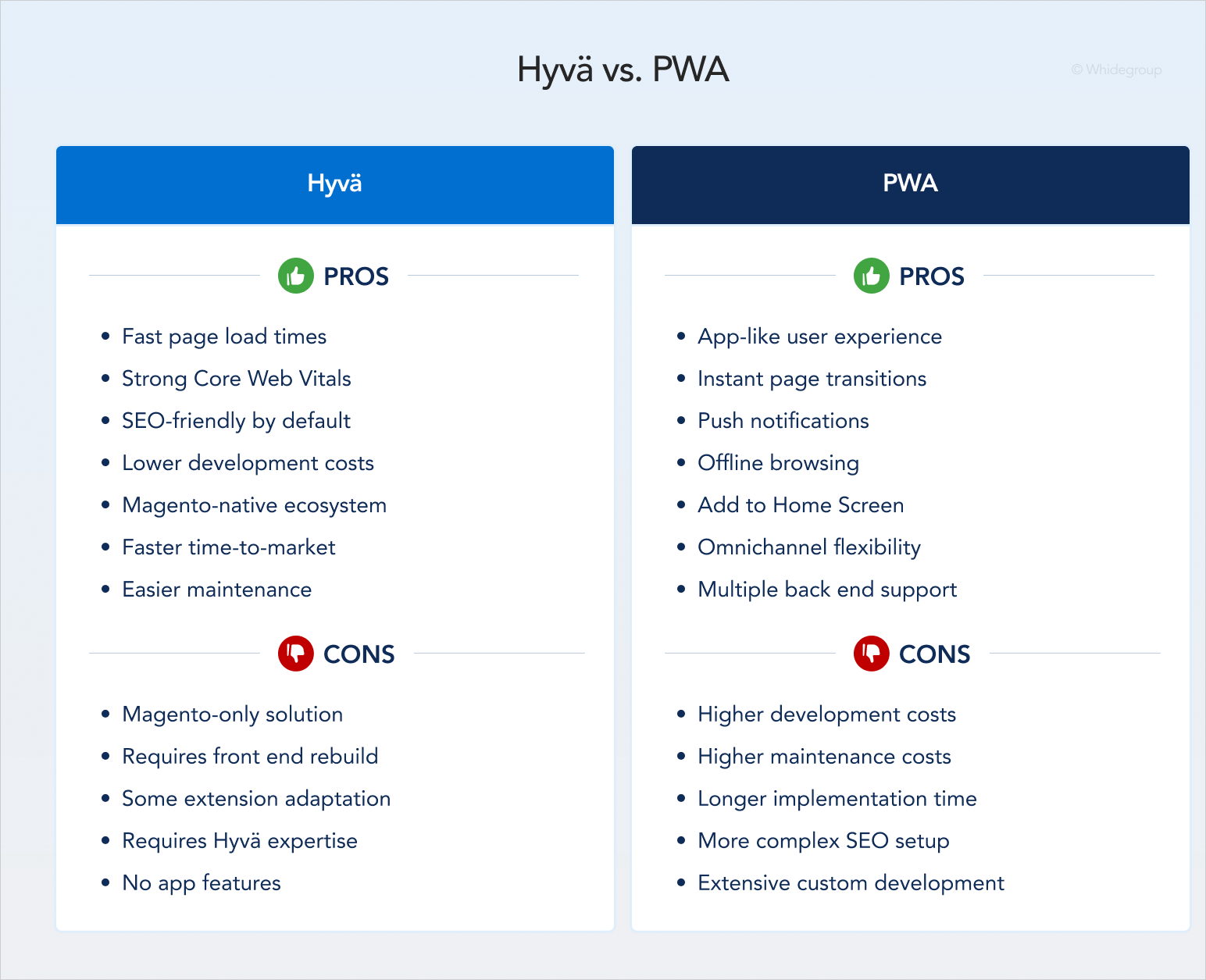
Key Hyvä benefits for business:
You can read more about why merchants choose the Hyvä theme in our dedicated article.
Main Hyvä drawbacks:
Work with a team that has hands-on Hyvä delivery experience.
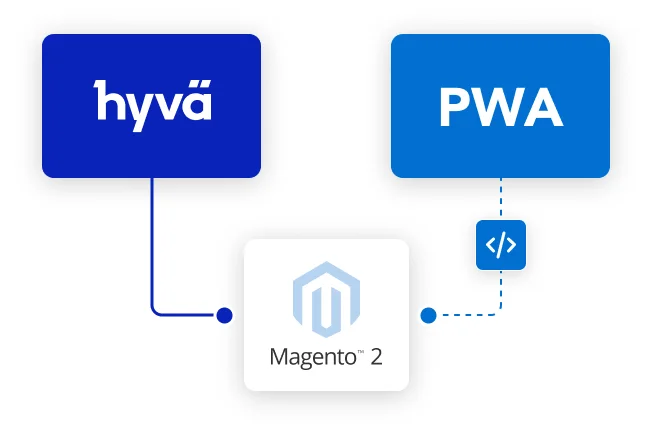
Progressive web apps (PWAs) bring app-like interactions to the web browser, including instant page transitions, home screen installation, and push notifications. For Magento stores, this storefront choice means adopting a headless architecture where the front end is separated from the back end and connected through APIs. As a result, PWAs offer greater flexibility, but they also require more planning, development effort, and investment than Hyvä implementation.
Key PWA benefits for business:
PWA drawbacks:
In this section, we take a closer look at the similarities and differences between Magento PWA and Hyvä. The table below summarizes the key characteristics for quick comparison. After the table, we explain each parameter in more detail.
| Feature | Hyvä Themes | Magento PWA |
|---|---|---|
| Architecture & tech stack | Monolithic Magento front endPHP, Tailwind CSS, Alpine.js | Headless storefrontReact / Node.js, GraphQL, Magento API |
| Performance | Consistently strong out of the boxGreen Core Web Vitals with correct setup | High speed after first loadHighly dependent on front-end architecture and code quality |
| SEO | Native and predictableServer-side rendering by default | Requires specialized SSR/ISR setups to ensure Google crawls all content |
| User experience | Fast website feelResponsive design across devicesMobile-optimized web experience | App-like interactionsInstant transitionsAdd to home screenOffline mode*Push notifications |
| Scalability | Scales well within Magento 2 ecosystem | Fully decoupled front endIndependent scaling from back endRequires custom UI for almost every 3rd party Magento module |
| Time-to-market | 1–3 months for midsize stores | 6+ months, often 12+ for enterprise |
| Cost | Development: $10,000–30,000Maintenance: from $4,000/year | Development: from $50,000Maintenance: ~20% of development cost/year |
*Offline in ecommerce: the shopping cart and checkout still require a connection to the server, so offline mode is only useful for viewing content that has already been downloaded.
Hyvä
The Hyvä theme for Magento 2 keeps your store within the Magento ecosystem without changing the entire storefront architecture. Standard Magento workflows, back-end logic, and many extensions can remain part of the setup, although custom modules still need compatibility checks.
When does it matter? Hyvä is safer when you want to modernize the Magento front end without turning the project into a full architectural rebuild.
PWA
PWAs separate the storefront from the Magento back end and connect both layers through APIs. The approach provides more flexibility to create app-like experiences, connect disparate systems, or manage multiple front ends.
What is the trade-off? Greater architectural freedom also means more responsibility: API planning, custom development, SEO setup, and long-term maintenance become part of the project from the start. Features that come naturally in a traditional Magento setup often need to be rebuilt or connected separately.
Hyvä
Hyvä was built to improve Magento storefront performance. When the theme is implemented correctly, stores achieve strong Core Web Vitals scores and high PageSpeed Insights results without extensive front-end engineering.
For search engines, Hyvä uses classic server-side delivery, which means search bots see a fully finished page immediately. Hyvä is also compatible with standard Magento SEO tools, preserving your current search rankings.
Why is it safer? Hyvä delivers faster website speed along with keeping SEO ranking predictable. This combination reduces launch risk and SEO-related issues during and after the migration.
PWA
After the first page view, PWA stores make navigation feel much faster because the storefront prepares some content in advance and refreshes it when needed.
However, search engine visibility requires much more work. SEO setups are not active by default. While tools like Magento PWA Studio help, custom builds require heavy extra coding to ensure search bots can properly crawl every product URL and page layout.
What is the trade-off? PWA gives more room to design a smooth customer experience, but the result depends heavily on implementation quality. Without rendering, caching, routing, and SEO setup, the store can become expensive to maintain without delivering the expected performance gains.
Both Magento front-end options deliver high website speed, which remains a key performance-related driver of customer satisfaction, but they require different levels of custom development.
Hyvä
Hyvä provides a ready-to-use foundation for building a modern Magento 2 theme. The ecosystem includes UI components and compatibility with many popular Magento extensions, which reduces the amount of custom front-end work required during development.
The theme also supports extensive customization, allowing merchants to tailor the storefront to their brand and customer expectations without rebuilding every interface element from scratch.
When does it matter? Hyvä is often the better choice when you want a modern user experience without significantly increasing development scope, timeline, or budget.
PWA
PWA storefronts focus on creating app-like experiences. Instant page transitions, smooth animations, interactive product configurators, and advanced customer dashboards make complex shopping journeys feel faster and more engaging.
PWAs also support features such as push notifications and “Add to Home Screen”, helping stores encourage repeat visits without requiring customers to install a native mobile app.
What is the trade-off? PWAs give more freedom to create unique customer experiences, but most interface elements must be designed and developed specifically for your project. As a result, achieving that flexibility usually requires more development time, a larger budget, and ongoing front-end support.
Hyvä
As your catalog grows from 1,000 to 100,000 products, Hyvä remains stable because it uses Magento native logic. Experienced Hyvä developers can build and extend almost any feature needed to support ecommerce growth.
What is the trade-off? Tightly connected to Magento, Hyvä is safer if you plan to stay with this CMS for the long haul. If you decide to move to another ecommerce platform in the future, the storefront cannot move with you.
PWA
A PWA frees you from platform limits. It can combine data from Magento, ERP systems, CMS platforms, and other business tools into a single customer experience. The same headless architecture can also power multiple storefronts, websites, or customer portals.
What is the trade-off? PWA offers significantly more flexibility, but every new integration, data source, or storefront requires additional API development and maintenance. The more systems involved, the higher the implementation and support costs.
Hyvä
Implementation and customization of Hyvä for a midsize Magento store typically takes one to three months, assuming the project does not involve extensive custom functionality.
The ecosystem already has a solid documentation base, experienced Hyvä development companies, and a developer community that can help with raised issues.
Why is it safer? Because the system has clear setup guides and a wide Hyvä community, development teams face very few unexpected roadblocks during the project.
PWA
A project with a PWA Magento 2 storefront typically takes at least six months, even for a relatively simple ecommerce store. If the goal is to replicate standard Magento theme functionality and add custom features, the timeline extends further. Enterprise-level PWA projects often take more than a year.
PWA projects take longer because features that work out of the box in a traditional Magento storefront require additional development in a headless architecture. Customer accounts, checkout flows, order tracking, payment integrations, real-time inventory updates, and ERP or CRM connections all need separate planning and implementation.
What is the trade-off? PWAs give you more freedom to design a unique store, but your team becomes responsible for connecting and maintaining many features that Magento normally handles more predictably.
Hyvä
While the core theme previously required a paid license, the creators made the Hyvä Theme core open source and free to use. You can choose to add paid modules, such as Hyvä Checkout for €1,000, though a free alternative is also available.
Hyvä theme development projects typically start at $10,000. With a budget of around $30,000, it is possible to build a fairly complex storefront. Ongoing support costs are comparable to those of a standard Magento store, with annual maintenance plans typically ranging from $4,000 to $8,000.
When does it matter? Hyvä is usually the safer choice when you want measurable performance and UX improvements without committing to enterprise-level development budgets.
PWA
A Magento 2 PWA requires a significantly larger investment. While online estimates range from $10,000 to $30,000, those figures rarely reflect the needs of a real ecommerce business.
For midsize and enterprise stores, PWA projects typically start at $50,000 and can exceed $100,000 when multiple integrations, custom user experiences, or complex business processes are involved.
Maintenance costs are also higher. A common benchmark is to allocate about 20% of the initial development budget each year to support services.
What is the trade-off? PWA gives you an elite, platform-free storefront, but you pay a premium for both the initial build and ongoing maintenance.
We help choose the right front-end architecture to enhance your Magento store.
Both approaches improve performance and user experience, but they solve different problems. That’s why the choice comes down to business goals rather than technology preferences.
Hyvä is often the right option for merchants who want a fast, modern storefront without introducing the cost and complexity of a headless architecture.
Typical use cases include:
A good example of combined redesign and Hyvä migration project is Lichtnelke, a German garden plant retailer. The company approached us for a redesign and UX improvements during its low season. After reviewing the project goals, we combined the redesign with a migration from Porto to Hyvä.
The result was an updated storefront, improved user experience, and a PageSpeed Insights score increase from 67 to 94. More than three years later, the website continues to pass Core Web Vitals assessments consistently.
Performance Metrics: Before and After Hyvä Migration
| Metric | Before Migration | Immediately After Migration | Three Years Later |
|---|---|---|---|
| Performance score | 67 | 94 | 93 |
| Largest Contentful Paint | 3.7 s | 1.5 s | 1.5 s |
| Cumulative Layout Shift | 0.158 | 0.006 | 0.003 |
| Speed Index | 2.1 s | 1.1 s | 0.9 s |
PWA is often presented as a universal fix. In practice, given the cost and development timeline, Magento PWA delivers real business value only for a limited set of scenarios.
PWA becomes a strong choice for:
Here is how we choose the right Magento front end for each client.
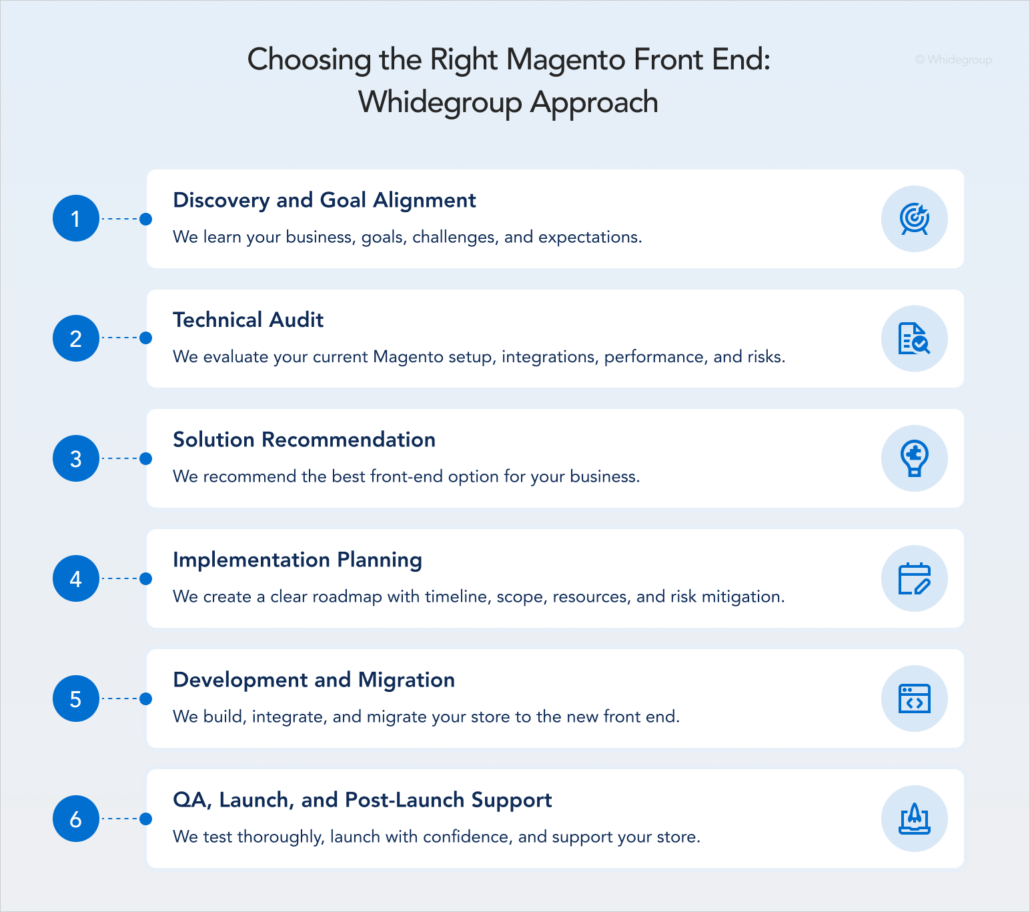
We never start a project with a pre-selected solution. Our process begins with a thorough discovery phase where we analyze:
The goal is to understand what success looks like for your business before discussing implementation options.
Next, our Magento architects review your existing ecosystem to determine which front-end solution is best and what challenges may arise during implementation.
The audit includes:
Based on the discovery findings and technical audit, we recommend the approach that best supports your business goals:
We explain the benefits, limitations, implementation complexity, and long-term maintenance implications of each option. You also receive estimated timelines, budget ranges, and key risks for every scenario. The final decision remains yours, backed by clear technical and business recommendations from our team.
Once you approve the approach, we create a detailed roadmap with clear milestones and assign the right specialists to your project:
During development, our team builds the new storefront while preserving your essential store logic. A front-end change does not require database migration. Your product catalog, customer accounts, order history, and other critical business data remain safely stored in Magento.
The development scope depends on the chosen Magento 2 storefront:
After development is complete, the final steps include:
Contact us for a free consultation.
Hyvä and PWA solve different problems, even though both aim to improve storefront performance and user experience. Hyvä focuses on speed, simplicity, and predictable development within the Magento ecosystem. PWA targets complex, headless scenarios where front-end independence and advanced UX justify higher cost and longer timelines.
There is no universally “best” Magento front-end option. The right choice depends on your business stage, growth plans, technical landscape, and internal resources. For most stores, Hyvä offers a balanced mix of speed, cost, and scalability. For others, a PWA can support long-term strategy and justify high initial investments.
If you’re unsure which front end fits your Magento store, a quick technical and business review can clarify the right path. Contact our team to assess your setup and recommend a solution that matches your goals.
Yes. Whidegroup is a Magento partner with deep expertise in both architectures. We evaluate your business goals to recommend either Hyvä themes for Magento 2 or a custom PWA development. Our goal is to provide the best ROI, not just the trendiest technology.
For mid-size Magento stores, Hyvä theme migration typically takes 1–3 months. The exact timeline depends on design complexity, custom functionality, and the number of third-party extensions.
Yes. We integrate both Magento PWA and Hyvä themes with modern or legacy external tools and software, such as ERP, CRM, PIM, analytics, marketing automation systems, etc. The integration approach depends on whether data flows through Magento or directly via APIs.
In most cases, yes. Many Magento extensions already support Hyvä. For PWAs, extensions usually require partial or full front-end adaptation. We audit your extensions early and define the migration scope before development starts.
If an extension isn’t Hyvä-compatible, we either develop custom adaptation or replace it with a supported alternative.
Not necessarily. Hyvä typically works on existing Magento hosting setups. Magento PWA themes can also run on the same hosting. However, progressive web applications can be deployed on separate servers to support independent scaling. The choice depends on business requirements and plans for growth.





One of the challenges of retheming is that the entire front end needs to be redesigned. This requires organizing all the existing elements, which takes time and budget. Our project, as I believe like many other long-standing ones, had accumulated some low-quality elements and implementations over the years. When we switched to Hyvä, we used the opportunity to clean all that up. The project is now in a much healthier state. Henning Bargest, Head of IT Department at Lichtnelke