Magento Website Development Cost: Full Pricing Breakdown for 2027
 11 mins read

 11 mins read
At Whidegroup, Magento website development costs start from $9,500 and can exceed $80,000 for complex projects. The range is wide because we estimate each project individually, based on the business’s specific needs.
Two stores can target the same market and sell similar products but require very different development budgets. Catalog structure, integrations, custom business logic, and UX requirements all influence the final cost. Understanding these factors helps you evaluate project estimates and avoid paying for what your business doesn’t need yet.
In this article, we break down Magento development costs for 2027 and share expert tips on how to optimize your budget.
Plan and build your Magento store with one team.
First, we provide reference price ranges to help you estimate how much Magento 2 costs.
What’s included:
For small businesses with standard ecommerce needs, Magento is often too complex for the actual scope. In these cases, Shopify store development can be a more practical choice because it reduces launch complexity and ongoing maintenance costs.
What’s included:
What’s included:
You now have a rough idea of what Magento development can cost for a business of your size. Below, we explain the main factors that shift the price toward the lower or upper end of the given ranges.
Many business owners start with a simple question: how much is Magento? From Whidegroup experience, the biggest cost driver is usually the amount of custom development required. Storefront design, integrations, and a Magento agency you hire also play a role.
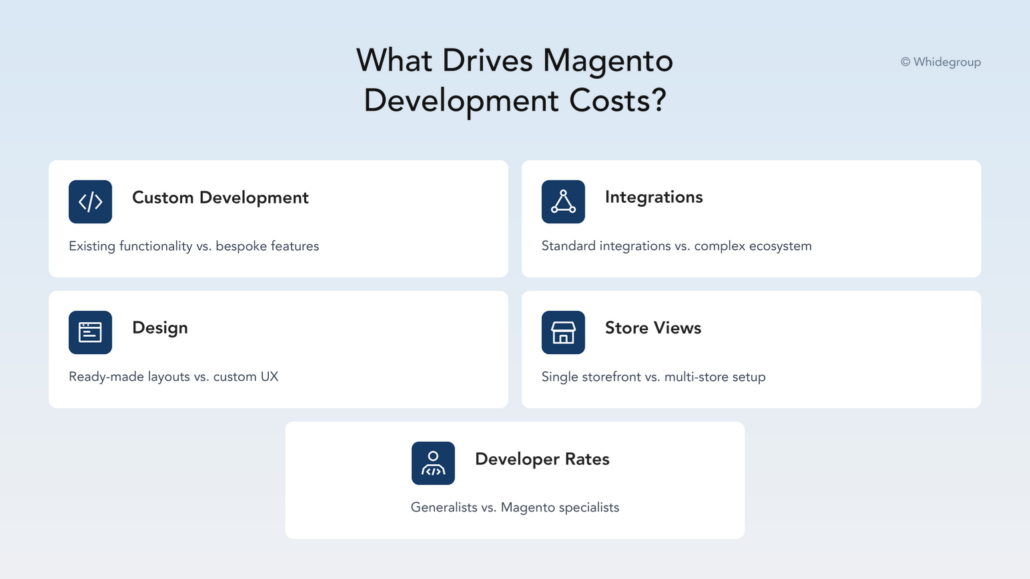
The price of your storefront design depends on two main questions.
If your development vendor needs to research your niche first, the design phase takes more time. Clear references that reflect customer expectations and sales goals help development move faster and cost less.
Complex Figma details can be recreated exactly, but they may increase development time and cost. When budget matters, developers can suggest small adjustments that simplify implementation without changing the core customer experience.
A ready-made theme can reduce the initial Magento site development cost because you do not create every layout from scratch. But, many ready-made Magento themes are based on the old Luma front-end stack, which can create performance limitations and increase optimization costs later.
A custom design, especially when built with Hyvä, usually requires more upfront work. However, it gives you more control over UX, performance, and long-term flexibility.

Your Magento store may need to connect with different services depending on how your business operates:
More integrations generally mean higher development costs. And it’s not just a matter of mechanically calculating the price based on the number of integrations. Adding more integrations can lead to compatibility issues, both between extensions and with the Magento core. This ultimately increases the time required to develop and launch the store.
Customization can range from minor changes to existing features to building new integrations or modules from scratch. The amount of work required affects the Magento development price and can also increase ongoing support costs.
Case in point
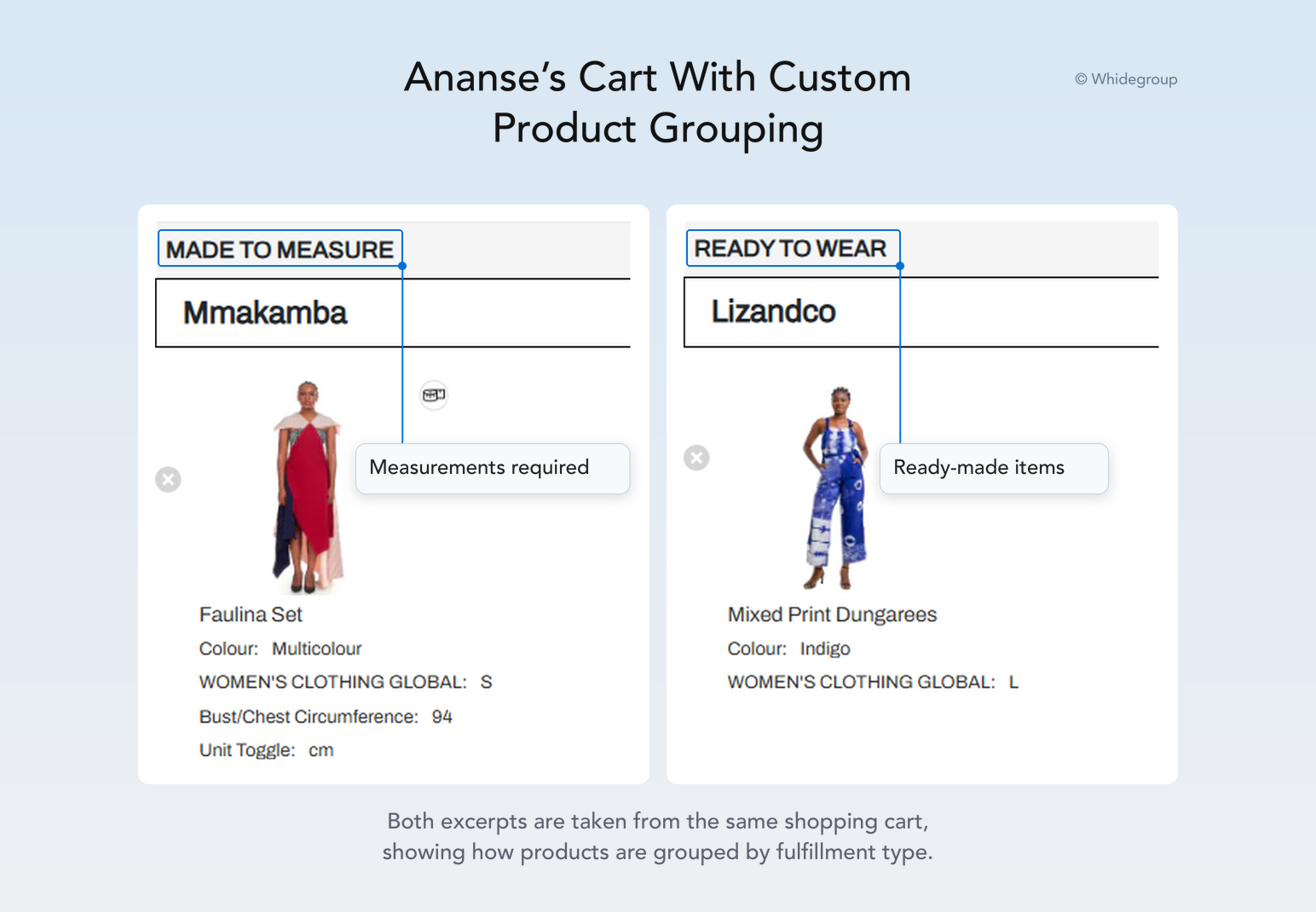
While working with the Ananse design marketplace, we customized the cart page to group products by type for a smoother shopping experience. Customers can now quickly scan their orders to understand which items will arrive soon and which ones will take longer to make. Shoppers can also see where they need to provide measurements so the seller tailors the clothing correctly.
Magento allows you to create different storefronts called store views that pull data from a single back end. This feature is often useful for:
Each additional store view increases the project scope, so the answer to “how much does Magento cost?” changes with every market and customer segment you add. We usually recommend launching the main revenue-generating store view first and adding other views in later project phases.
The final development cost depends on both hourly rates and the time required to complete your project. A lower rate may seem attractive, but it won’t necessarily reduce the final bill if the work takes longer or requires rework. That’s why we recommend comparing estimates based on the scope of work, expected hours, and Magento expertise.
When calculating how much a Magento 2 website costs, you’ll also need to account for differences in developer rates. Two factors largely explain these differences: company size and specialization, and location.
As you can see, prices vary significantly, making it possible to find a provider within different budget ranges. Before you choose, check reviews on independent sites or ask your business partners for advice. The cheapest options often carry a risk of poor quality, but a high price does not always guarantee great work.
The table below shows average timelines and costs for each project phase based on its complexity. Cost estimates are based on an hourly rate of $50 for a Magento specialist.
| Service | Estimated hours | Estimated cost, $ |
|---|---|---|
| Discovery & planning | ||
| Market research and planning | 24 | 1,200 |
| UX/UI design and front-end development | ||
| Luma theme configuration* | 12 | 600 |
| Luma theme customization* | 28–60 | 1,400–3,000 |
| Custom design in Figma | 36–64 | 1,800–3,200 |
| Hyvä theme development from a Figma design | 140+ | 7,000 |
| Development & integrations | ||
| Data migration from an old CMS | 20–60 | 1,000–3,000 |
| Extension integration and setup | 3–15 | 150–750 |
| Extension customization | 16+ | 800+ |
| Custom integration development | 48+ | 2,400+ |
| Custom extension development | 40+ | 2,000+ |
| Multi-store setup (per additional store) | 28–40 | 1,400–2,000 |
*For new Magento projects, we recommend Hyvä instead of Luma-based or legacy themes. Older theme stacks can limit performance and make future optimization more difficult.
Get a Magento cost estimate tailored to your business.
Building an online store involves steps that are not directly part of the development process but do affect your launch budget and total cost of ownership (TCO). We provide reference prices for these factors to help you plan a Magento store launch.
| Expense item | Estimated Annual Cost, $ |
|---|---|
| License | 0–1,000,000+ |
| Domain name | 10–1,000+ |
| SSL certificate | 0–1,500 |
| Hosting | 240–5,000+ |
| Support & maintenance | 5,400–84,000+ |
| SEO & promotion | 24,000–240,000+ |
Here’s a quick look at why the prices for each item vary so much:
Magento implementation costs pay off when your business needs custom business logic, complex integrations, and full control over the store. For businesses with standard ecommerce flows that want to launch quickly on a smaller budget, SaaS platforms are often more cost-effective.
Here’s how popular ecommerce platforms compare:
The features you prioritize and the way you plan development can affect how much Magento costs. Here are a few practical tips from our team to help you manage your budget.
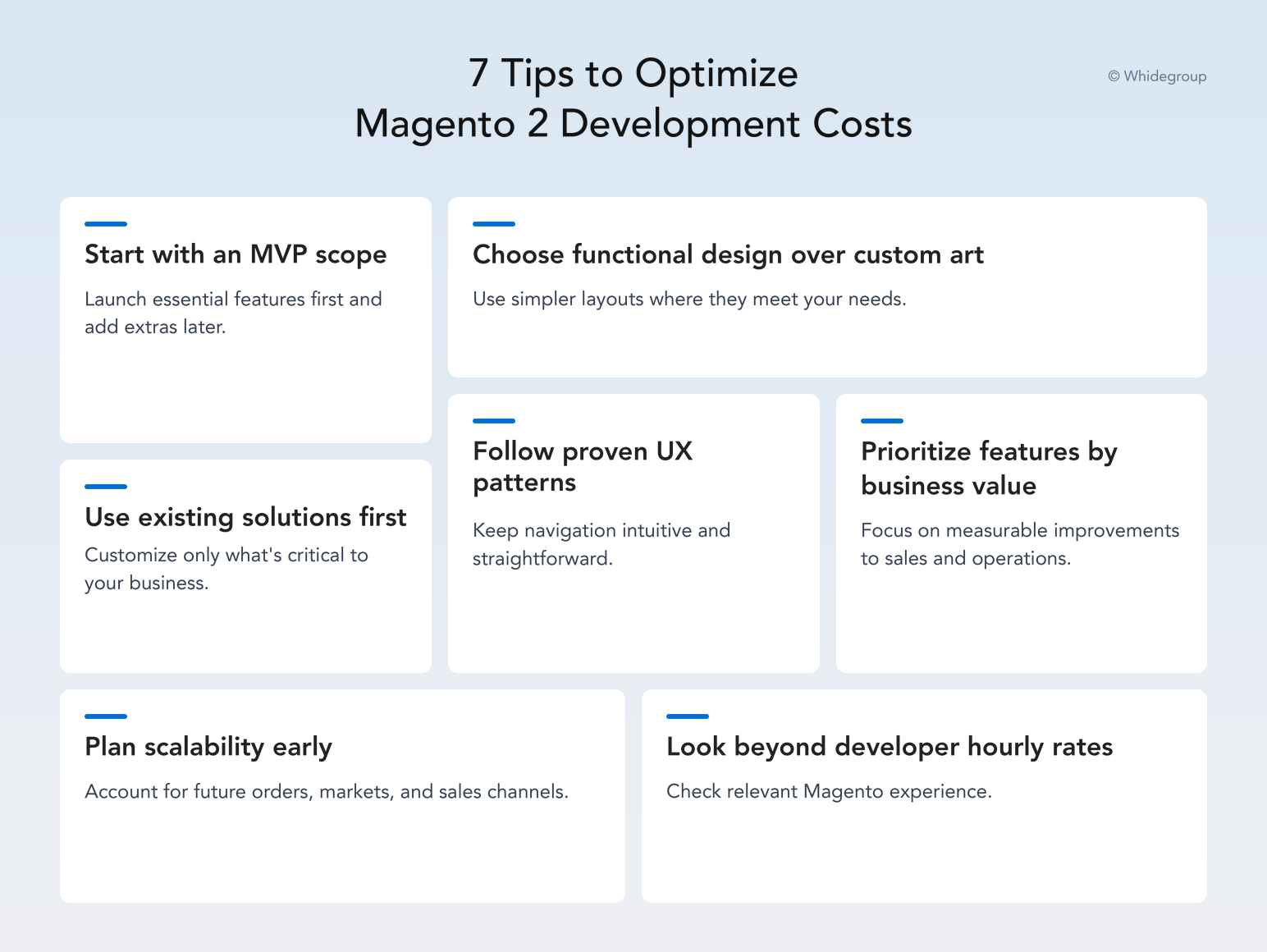
Limit your initial launch to essential functionality and add integrations, custom features, and localized store views in later project phases. A smaller scope reduces development and testing hours, helping you avoid upfront costs for features your business may not need.
Not every business needs a unique or cutting-edge front end to succeed. A custom-built design is expensive and takes months to develop.
Instead, focus on your customers’ needs and align the design with your marketing strategy. You can allocate the budget saved on custom design to features, integrations, or marketing activities that have a clearer impact on sales and customer experience.
Proven patterns cost less and carry less risk for your conversion. Shoppers expect the cart icon in the top-right corner, a clearly visible search bar, and a guest checkout option — and ready-made themes already follow these conventions.
In contrast, a non-standard interface requires extra design, development, and usability testing, and if customers find it confusing, you pay again to fix it. Use custom UX only when familiar patterns can’t meet a specific business need.
Each additional feature can increase Magento development costs. Before adding a feature to your development scope, identify the result it should influence and prioritize your feature list based on expected business impact and defer lower-priority changes.
This tip works for both initial store development and future optimization projects. For example, a checkout improvement that saves customers 30 seconds has a clearer business impact than a widget that only a small share of shoppers uses — so the widget can wait.
Magento’s built-in features and ready-made extensions usually cost a fraction of custom development because the code is already built and tested. We recommend using them where possible and customizing only the parts critical for your business goals.
When discussing a custom feature with your development team, focus on the business result you need. Developers may suggest a simpler, less expensive way to achieve a comparable result.
Case in point
A client wanted to implement new logic for complex promo rules. In their exact formulation, this functionality did not exist in the Magento core or in available extensions. Custom development was estimated at 80–100 hours.
In contrast, we found that changing a ready-made module would take only 15–20 hours. This path did not perfectly recreate the original idea, but it still increased the AOV and total sales for roughly one-fifth of the original cost.
Before development starts, share your realistic 2–3 year growth plans with your Magento team. Discuss expected order volume, new markets or currencies, and additional sales channels such as marketplaces, B2B, or POS.
The shared goals help the team choose proper solutions — a hosting provider, database structure, and extension set that can scale with higher requirements without costly rebuilds.
A low hourly rate does not always mean a lower final Magento development cost. If the team lacks Magento expertise, you may later pay for rework, performance fixes, or support from another contractor. To avoid the issues, choose a partner with proven Magento experience, relevant case studies, and strong reviews.
Magento generally requires a larger development budget than a standard SaaS store. The additional investment makes sense when your business needs complex integrations and custom workflows. Even then, you can control costs by keeping the initial scope focused and using ready-made solutions where possible.
Want to plan your Magento development budget? Book a free consultation to review your project scope, identify opportunities to reduce costs, and determine where custom development is necessary.
Magento development typically takes 3 to 6 months for a mid-custom store. Complex projects for enterprise businesses, especially with multiple store views, can take 6 to 12 months and more.
Yes. Magento is a complex platform that requires deep knowledge of PHP and specialized database structures. General web developers often struggle with Magento’s unique architecture. Hiring a dedicated expert ensures your store is secure, follows coding standards, and can handle high traffic.
Lower-cost agencies may have less Magento expertise, which can result in poor code quality, slow performance, or security vulnerabilities. These issues often require additional development work later, increasing the total cost of the project.
Magento is built to support business growth. Developers can scale the store’s architecture and infrastructure to handle larger catalogs, higher order volumes, and expansion into new markets or sales channels.
Yes. You can reduce development hours by using Magento’s built-in features or adapting existing extensions instead of building everything from scratch. Keep business-critical functionality in your launch scope and leave nonessential customizations for later phases.
Custom development usually has the biggest impact on Magento website development costs. Using Magento’s built-in functionality or existing extensions usually requires less work than building features from scratch. Costs increase when your project involves:
• Custom business logic: complex pricing rules, product configurations, or non-standard checkout and order management processes.
• Complex integrations: connecting Magento with ERP, PIM, or warehouse systems when ready-made connectors cannot meet your requirements.
• Custom storefront development: unique layouts and shopping flows that require additional design, development, and testing.
For example, configuring an existing payment extension often costs less than building a custom ERP integration that synchronizes inventory, pricing, and orders.
At Whidegroup, we don’t recommend Magento for small businesses. The platform’s development and maintenance costs are often difficult to justify when a store has straightforward requirements. SaaS platforms are usually a more affordable option.
However, some small businesses have complex pricing rules, product configurations, or integration requirements that are difficult to accommodate on SaaS platforms. In such cases, Magento may be worth considering, but only after comparing the available alternatives and their long-term costs.
Post-launch warranty fixes for issues related to the original development work may be included in the project cost. But ongoing maintenance, including security updates, performance monitoring, and compatibility fixes, is a separate service and is billed separately.